Our Curriculum Intent
By the end of their time at Hodge Clough Primary, we want children to have learned, improved and embedded a range of artistic skills. They should have an awareness of a broad range of artists and crafts people and be able to consider and discuss the artworks they come across. We want our pupils to be confident to explore, experiment and take risks, placing value on the process and journey that they take, not just on the finished product. Most importantly, we want children to have found and enjoyed a creative outlet – a means of self-expression and enjoyment.
 |
Art - National Curriculum |
|
Development Matters for the EYFS- Expressive arts and design |
What we will learn
At Hodge Clough Primary School, we will achieve our aims by:
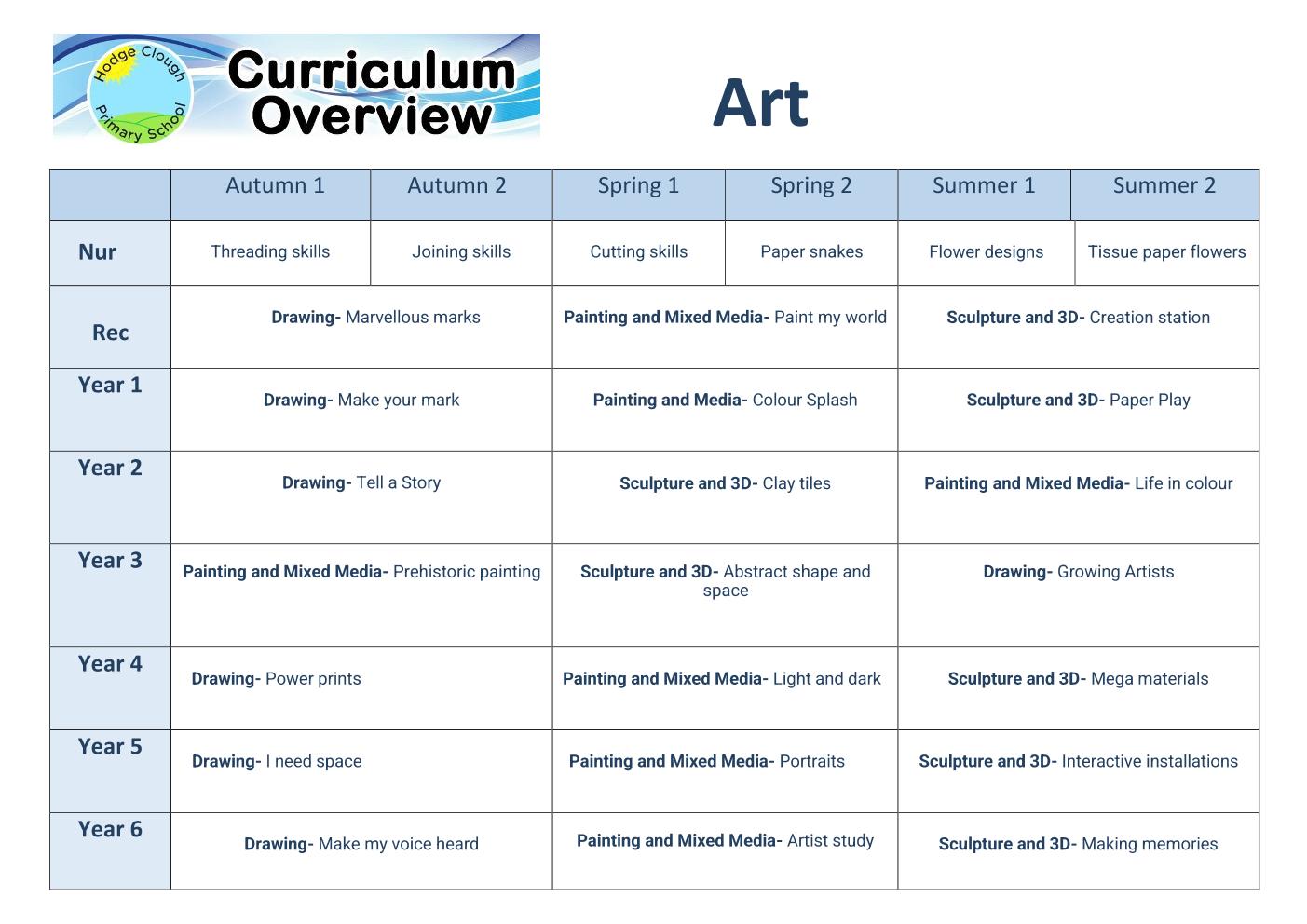
• Teaching art regularly. The children will cover an art topic at least once every term and will also have additional opportunities to engage with art and design activities throughout the school year.
• Linking art as closely as possible to the topic for the term, to ensure relevance and context.
• Teaching a predominantly skills-based curriculum, which covers drawing, painting, sculpture, textiles and printing.
• Re-teaching skills throughout the children’s time in school. Skills are revisited and perfected through a spiral curriculum, which progresses in terms of depth and challenge, to build on the children’s previous learning.
• Ensuring that each child develops their skills and techniques in a way appropriate to them, through clear differentiation and support, active and purposeful experiences, and using a variety of art materials and teaching strategies.
• Fostering an enjoyment and appreciation of the visual arts and a knowledge of artists, craftspeople and designers, to introduce pupils to a wide range of contemporary and historical artists and crafts people.
• Introducing children to artists and art movements directly linked to the skills or topics they are covering.
• Utilising a sketchbook approach, so that children feel safe to experiment and take risks, without the fear of doing something ‘wrong’.
• Openly promoting art and design as a possible further study or career choice.
• Encouraging each child to evaluate their art and design work and that of others, both with peers and adults.
• Celebrating effort, progress and achievement in art through displays and enrichment activities.