
Read Write Inc Phonics
At Hodge Clough Primary we use Read Write Inc Phonics (RWI) to give your child the best possible start with their reading and writing.
For more information on our Reading curriculum please contact our Reading Lead, Jade Wood.
What is Read Write Inc?
Read Write Inc (RWI) is a phonics based programme which helps children learn to read whilst also developing a wide range of vocabulary and encouraging a love of stories. It was developed by Ruth Miskin a leading consultant on early reading.
Children who read regularly or are read to regularly have the opportunity to open the doors to so many different worlds! More importantly, reading will give your child the tools to become independent life-long learners.
We can achieve this together through:
- Read Write Inc, a program to help to your child read at school
- Encouraging children to develop a love of books by reading to them daily, at home and at school
- Giving children access to a wide range of books at school and at home
 |
How the Read Write Inc. phonics works - a parent/carer’s guide |
How does Read Write Inc work?
Your child will learn to read in a very simple way. He or she will learn to:
- Read letters by their ‘sounds’
- Blend these sounds into words
- Read the words in a story
They experience success from the very beginning. Lively phonic books are closely matched to their increasing knowledge of phonics and ‘tricky’ words and, as children re-read the stories, their fluency increases.
Along with a thought-provoking introduction, prompts for thinking out loud and discussion, children are helped to read with a storyteller’s voice.

Step 1
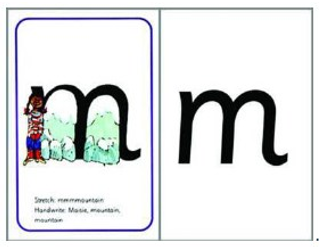
Children are first taught the set 1 sounds. We do not use letter names at this stage; we simply focus on the sounds that are used to sound out words.
m, a, s, d, t, i, n, p, g, o, c, k, u, b, f, e, l, h, sh, r, j, v, y, w, th, z, ch, qu, x, ng, nk
This video shows you how to pronounce each of these sounds. https://www.youtube.com/watch?v=yln6PpV1G1I
At this stage, the children are not only taught the sound the letter makes but also how to form the letter, using a rhyme and a picture prompt.
Step 2
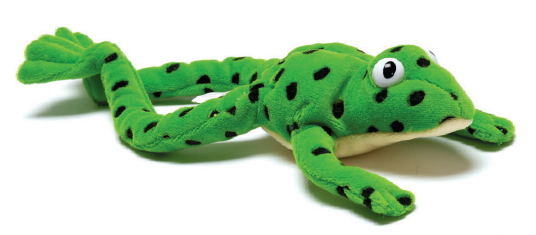
Children use these sounds to sound out words. A character called Fred is introduced. He talks only in sounds
Children are asked to interpret what Fred is saying like this: Fred says ‘m-a-t’, we would say ‘mat’, Fred says ‘f-r-o-g’, we would say ‘frog’
So, when you hear your child say ‘Fred Talk’, you’ll know this means sounding out the word.
Once children are confident in reading set 1 sounds speedily and can understand Fred they will start to read the RWI storybooks.
Step 3
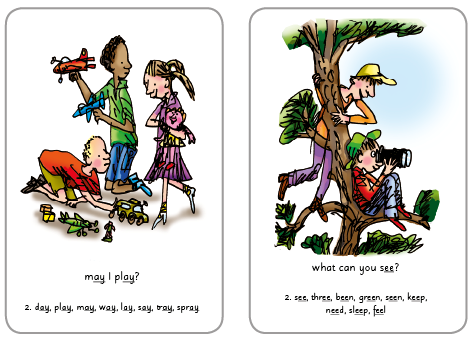
Children are then taught Set 2 Sounds. When they are very confident with all of set 1 and 2 they are taught Set 3 Sounds. Each Set 2 & 3 sounds have a picture and phrase to help your child remember the sound. For example:
- The sound ‘ay’ has the phrase ‘May I play?’ with a picture of children playing togethe
- The sound ‘ee’ has the phrase ‘What can you see?’ with a picture of two boys in a tree
Red words
These are words that are unable to be sounded out as they are irregular. Children simply have to learn to recognise, read and spell these words as they cannot be sounded using any sort of phonics strategy.

Nonsense Words (Alien Words)
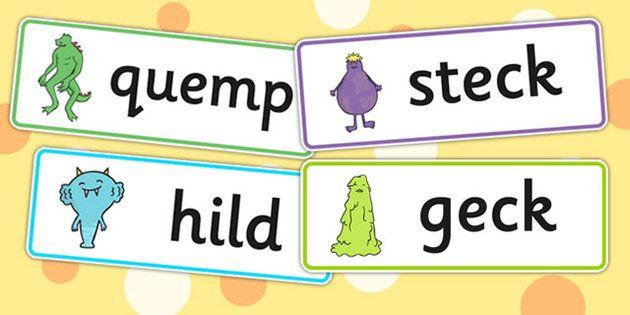
As well as learning to read and blend real words children will have plenty of opportunities to apply their sound recognition skills on reading ‘Nonsense words’. These words will also feature heavily in the Year One Phonics Screening check in the summer term.
What Books Will My Child Bring Home?
Book Bag Books
Your child will bring home a Book Bag Book. This book builds upon the ideas and many of the words in the Storybook he or she has just read in school. Your child will need more support in reading this book. Again, explanations of how to use the activities are included in the books.
As soon as your child starts to read the Read Write Inc. Phonics Storybooks, he or she may bring home a black and white Storybook. This is a copy of the colour version he or she will have read at school.
Your child will have read this story three times with their reading teacher, so should be able to read the story confidently. A brief explanation of how to follow the activities is included in the books.

How can I help my child at home?
- Establish a routine to include regular reading throughout the week
- Have fun with ‘Fred Talk’ at home eg Where is your c-oa-t? Time for b-e-d!
- Encourage your child to ‘Fred Talk’ or ‘sound out’ any unfamiliar words.
- Read as many stories to your child as you can. Traditional tales, stories from other cultures, poetry, their favourite story– talk about stories with them.
- Explain the meaning of new words.
- Fill in the parent comments in your child’s reading diary to keep us informed of how reading is going at home.
Achievements
By the end of Reception children will be able to
Read words and simple sentences consistent with their phonic knowledge by sound-blending including some common exception words.
Write recognisable letters, most of which are correctly formed.
Write a simple narrative in short sentences with known letter-sound correspondences.
By the end of Key Stage 1 children will be able to
Know all taught graphemes so that decoding becomes fluent and secure.
Check that what has been read makes sense, and self-correct reading where necessary. Answer questions and make some inferences.
Write a range of coherent independent pieces.
Spell common words and use punctuation correctly and consistently.
By the end of Key Stage 2 children will be able to
Fluently read a wide variety of texts across a range of subjects; both for meaning and for pleasure.
Analyse pieces of writing and use a range of skills to answer questions, such as inferring, predicting and summarising.
Use a wide range of vocabulary and grammatical conventions.
Write a range of independent pieces, editing and improving their writing against a given framework.
Children will understand that this a process ‘real writers’ use and that they have become writers themselves.