What children will learn
Physical literacy (building physical competency alongside confidence, enjoyment, knowledge and understanding) and high quality PE lessons that engage children of different backgrounds and abilities should be a fundamental part of every child’s school experience.
The National Curriculum for Physical Education aims to ensure that all children:
- develop competence to excel in a broad range of physical activities
- are physically active for sustained periods of time
- engage in competitive sports and activities
- lead healthy, active lives
What children will know
Aims and expectations for each key stage
In the Early Years Foundation Stage, Physical Development is broken down into two aspects:
- Moving and Handling
- Health and Self-Care
Gross and fine motor experiences develop incrementally throughout early childhood, starting with sensory explorations and the development of a child’s strength, co-ordination and positional awareness. By creating games and providing opportunities for play both indoors and outdoors, adults can support children to develop their core strength, stability, balance, spatial awareness, co-ordination and agility. Gross motor skills provide the foundation for developing healthy bodies and social and emotional well-being. Fine motor control and precision helps with hand-eye co-ordination, which is later linked to early literacy.
By the end of Reception, children should be able to:
- Confidently try new activities and show independence, resilience and perseverance in the face of challenge; -
- Explain the reasons for rules, know right from wrong and try to behave accordingly;
- Manage their own basic hygiene and personal needs, including dressing, going to the toilet and understanding the importance of healthy food choices.
- Negotiate space and obstacles safely, with consideration for themselves and others;
- Demonstrate strength, balance and coordination when playing;
- Move energetically, such as running, jumping, dancing, hopping, skipping and climbing
- Fine motor control – hold pencils and small tools effectively and with greater accuracy and precision
By the end of Key Stage One, children should be able to:
Children should develop fundamental movement skills, become increasingly competent and confident and access a broad range of opportunities to extend their agility, balance and coordination, individually and with others. They should be able to engage in competitive (both against self and against others) and co-operative physical activities, in a range of increasingly challenging situations.
Children should be taught to:
- master basic movements including running, jumping, throwing and catching, as well as developing balance, agility and co-ordination, and begin to apply these in a range of activities
- participate in team games, developing simple tactics for attacking and defending
- perform dances using simple movement patterns
By the end of Key Stage Two, children should be able to:
Children should continue to apply and develop a broader range of skills, learning how to use them in different ways and to link them to make actions and sequences of movement. They should enjoy communicating, collaborating and competing with each other. They should develop an understanding of how to improve in different physical activities and sports and learn how to evaluate and recognise their own success.
Children should be taught to:
- use running, jumping, throwing and catching in isolation and in combination
- play competitive games, modified where appropriate [for example, badminton, basketball, cricket, football, hockey, netball, rounders and tennis], and apply basic principles suitable for attacking and defending
- develop flexibility, strength, technique, control and balance [for example, through athletics and gymnastics]
- perform dances using a range of movement patterns
- take part in outdoor and adventurous activity challenges both individually and within a team
- compare their performances with previous ones and demonstrate improvement to achieve their personal best.
Swimming and water safety
All schools must provide swimming instruction. In particular, children should be taught to:
- swim competently, confidently and proficiently over a distance of at least 25 metres
- use a range of strokes effectively [for example, front crawl, backstroke and breaststroke]
- perform safe self-rescue in different water-based situations
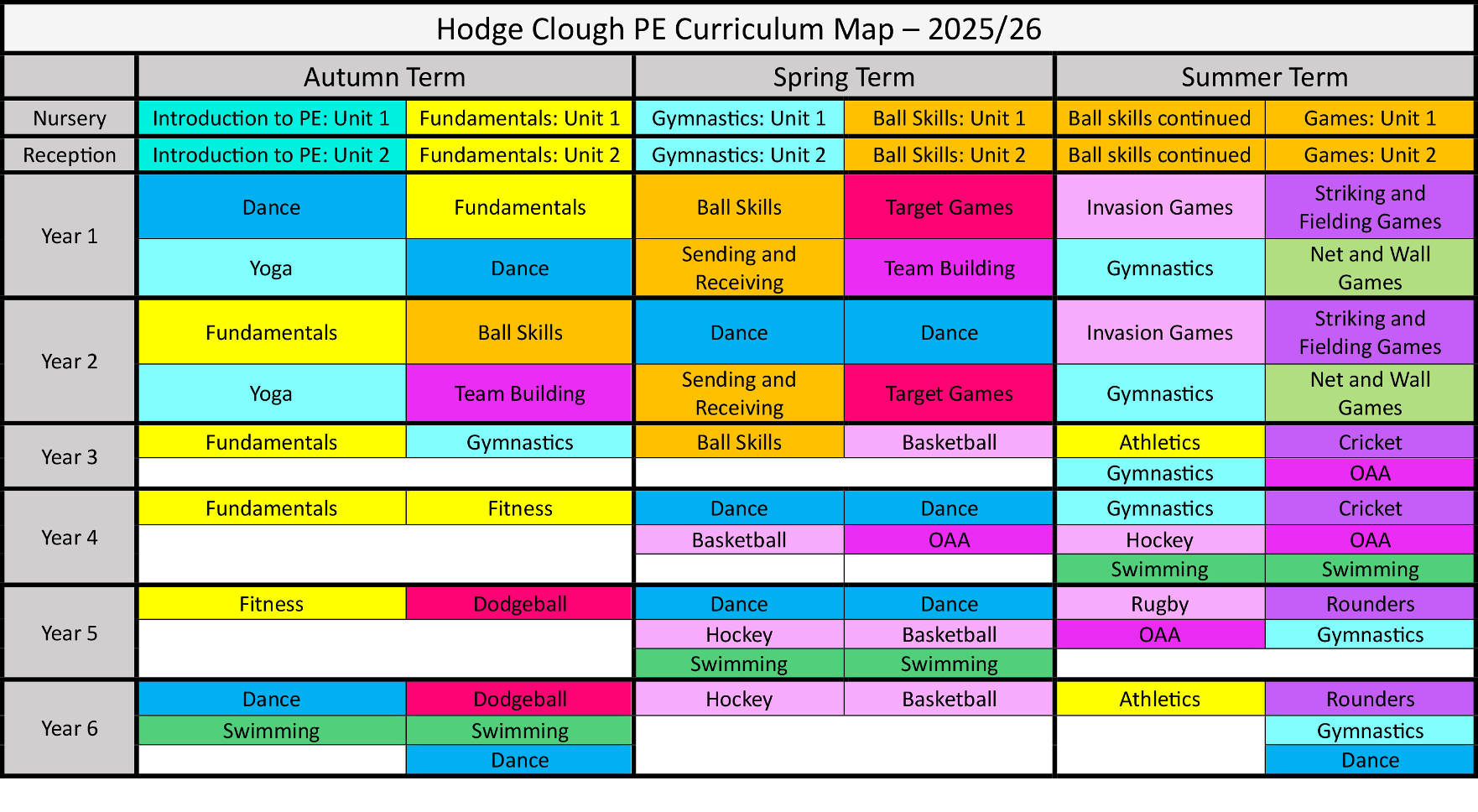

|
Hodge Clough PE Curriculum Map 25-26 | [pdf 75KB] |

|
|
|
Website PE skills and progression | [pdf 392KB] |
|